The Okwanuchu and Their Neighbors at
Upper Soda Springs
The answer to the question of who were the first people to actually live at or near Upper Soda Springs may depend on whom you ask.
For many current Native American tribes, their religion and their tradition teach them that their tribe were the first and only inhabitants on their land since the beginning of time, and they view the questions of when they arrived, or if others lived on the land before them, as irrelevant and against their teachings.
For many scientists, however, the question of who were the first inhabitants at different locations in North America is a fascinating puzzle, with new pieces being discovered every year.
In the late 1800's and early 1900's, scientists of that era realized that many Native American tribes were being killed or moved off their land, and that important information about these tribes was being lost. These scientists decided to interview living Native Americans, trying to learn and preserve as much as they could of their language, culture and history.
When those scientists interviewed tribal members around Mt.Shasta, in many cases there were only a few survivors left of some of the tribes who had been living there when the first European-Americans arrived in Northern California.
In particular, researchers found a group of tribes, related by language and culture, around Mt. Shasta, that they called the Shasta tribes. Included among the Shasta tribes was a tribe known as the Okwanuchu.
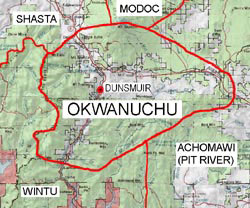
The Okwanuchu occupied territory south, southwest, and southeast of Mount Shasta, including the present-day cities of Mount Shasta, California and Dunsmuir, California. The Okwanuchu hunted and fished along the upper Sacramento River downstream to North Salt Creek, along the Squaw Valley Creek drainage, and along the upper McCloud River downstream to where it meets Squaw Valley Creek. To the north, were the lands of the Modoc, to the east, the Achomawi (also known as the Pit River Indians), to the south were the Wintu, and to the northwest were their closest relatives, the remainder of the Shasta tribes.
Important researcher and anthropologist Alfred L. Kroeber suggested in 1918 that the Okwanuchu had become extinct. Although their language was closely related to that of the Shasta, it contained some elements of Wintu and Achomawi.
Very little is known about the location of Okwanuchu villages and settlements, or about their culture, other than a presumed similarity to their Shasta language-speaking neighbors.