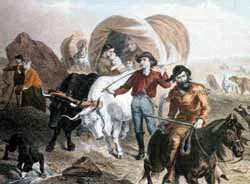
On a hot July day in 1853, a young woman bounced along in a covered wagon on the Oregon Trail. She was going to meet her husband in California, whom she hadn't seen for years. But she was facing a more serious and immediate problem. In the back of her wagon, her father lay dying.
The story of this young woman is an extraordinary tale of adventure and bravery, and it is a part of the extraordinary tale of the place where she would wind up, Upper Soda Springs, California.
The story of Upper Soda Springs begins long ago, before the arrival of humans in California.
Click on an image below to see more information
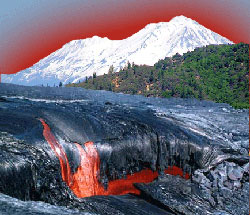
Mt. Shasta loomed over Upper Soda Springs, but the mountain had a surprise coming. Walls of lava poured from its base, and rolled down the Sacramento River canyon. Once this lava flow hardened, cold water springs began bubbling up, and the water was flavored by minerals it passed through. One of these mineral springs was Upper Soda Springs.
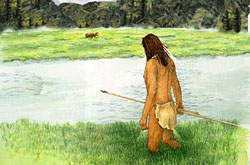
No one knows exactly who were the first humans to see Upper Soda Springs, and many believe that the first people arrived in California over 10,000 years ago. Some of these earliest humans likely started living near Upper Soda Springs.
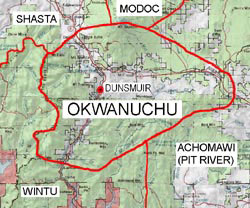
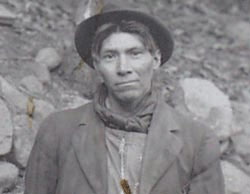
Waves of early humans moved through, with later arrivals displacing the earlier. By the 1800s, a tribe known as the Okwanuchu, part of the Shasta tribes, lived near Upper Soda Springs.
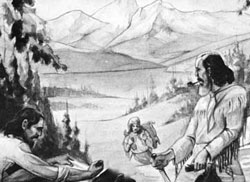
Early European and American trappers and hunters passed through Upper Soda Springs in the 1820s and 1830s, including some from the Hudson's Bay Company.
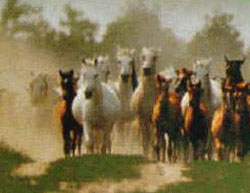
In the mid 1830s, enterprising Americans drove herds of horses and cattle from Mexican-controlled California to Oregon. In 1837, a monumental cattle drive came up the Sacramento River canyon and recorded a visit to Upper Soda Springs.
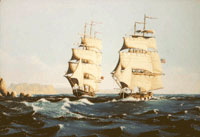
The United States Exploring Expedition sailed with six ships between 1838 and 1842, exploring the Pacific from Hawaii to Antarctica. In 1841, it sent an overland party south from Portland, Oregon. This exploring party came down the Sacramento River canyon and through Upper Soda Springs.
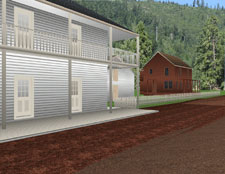
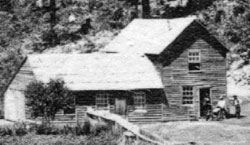
During the California Gold Rush, Forty-Niners spread throughout the state, including Siskiyou County. The first known inhabitants of Upper Soda Springs were the Lockhart brothers who, in about 1851, set up a rustic inn at Upper Soda Springs for prospectors and mule train drivers traveling from the Central Valley.
Among the Forty-Niners was a man named Ross McCloud, who was joined by his wife, Mary Campbell McCloud, after her tragic trip on the Oregon Trail in 1853 (described above). Together, they built a more substantial inn at Upper Soda Springs, as well as a toll bridge across the Sacramento River.
About this same time, the Tauhindauli clan of the Wintu tribe were forced out of their ancestral home on the Trinity River, and fled over the mountains to the Sacramento River. The Tauhindalis found a safe haven at Upper Soda Springs, protected from attack.
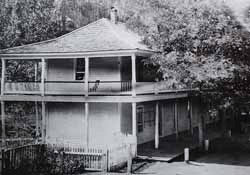
Life at Upper Soda Springs changed dramatically in the 1880s, when the Central Pacific Railroad was built, with a stop at Upper Soda Springs which became known as the Upper Soda Springs Resort. These next 30 years were the height of the Resort, as fashionable travelers came to "take the waters" at Upper Soda Springs.
By 1920, however, fashions in taking vacations changed, and the old Resort closed. Most of the original 160 acres was subdivided and sold for development of North Dunsmuir's homes and businesses.
Through private and public efforts, the City of Dunsmuir and the State of California have been acquiring parcels of the original Upper Soda Springs property, and converting the property to parkland.